
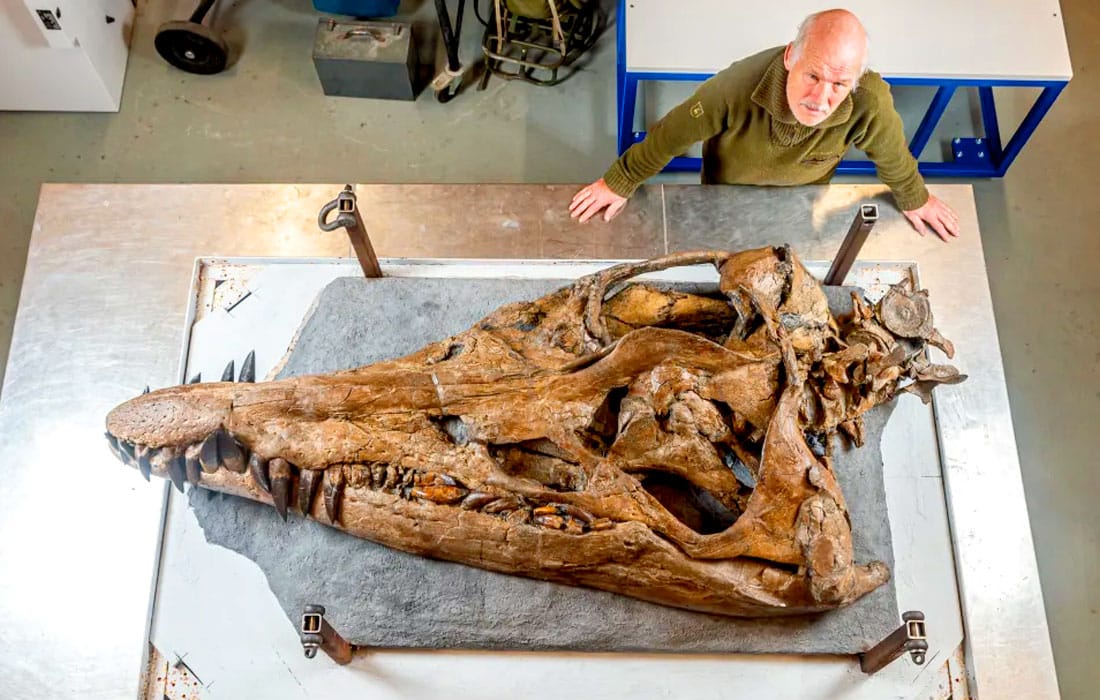

The skull of a gigantic sea reptile, a pliosaur, also known as the “Underwater T-Rex” has been discovered. Despite being about 150 million years old, it’s mostly intact.
In the cliffs of Dorset, a chilling 6-foot-long skull has been unearthed, revealing the remains of what scientists are calling an “underwater T-Rex” This astonishing discovery dates back a staggering 150 million years, providing a remarkable glimpse into the prehistoric world of the Jurassic Coast.
This formidable skull once belonged to a fearsome sea reptile, classified as a pliosaur. Experts have aptly named it a “killer machine” due to its menacing features, boasting a total of 130 killer teeth, including long, razor-sharp ridges. Among the fossil finds along the Jurassic Coast, this 6-foot-long pliosaur head stands out as one of the most complete examples to date, according to reports.
The creature could have been up to 12m long – as only the skull is bigger than the average human.
Dr Andre Rowe from Bristol University said: “The animal would have been so massive that I think it would have been able to prey effectively on anything that was unfortunate enough to be in its space.
“I have no doubt that this was sort of like an underwater T-Rex”, he added.
The ancient predator is set to feature in a special episode of the beloved BBC David Attenborough show on New Year’s Day. In the new episode, the TV star will unveil the impressive fossil for the first time.
Palaeontologist Steve Etches claimed the dinosaur is the first of its kind. He told BBC News: “It’s one of the best fossils I’ve ever worked on. What makes it unique is it’s complete. The lower jaw and the upper skull are meshed together, as they would be in life. Worldwide, there’s hardly any specimens ever found to that level of detail. And if they are, a lot of the bits are missing, whereas this, although it’s slightly distorted – it’s got every bone present.”
It was found in a towering cliff 15m above the Dorset beach while the scientist was taking a stroll near Kimmeridge Bay.
Steve and fellow fossil enthusiast Phil Jacobs spotted a tip of the snout of the dinosaur laying in the shingle. They then took a makeshift stretcher to carry it as it was extremely heavy.
Scientists now believe the rest of the animal could still be hiding inside the cliff.
Mr Etches said: “I stake my life the rest of the animal is there. And it really should come out because it’s in a very rapidly eroding environment. This part of the cliff line is going back by feet a year. And it won’t be very long before the rest of the pliosaur drops out and gets lost.”
The skull will be on display next year at the Kimmeridge museum in as part of the Etches Collection.
-Agencies
#pliosaur #dorsetcliffs #DavidAttenborough #BBC giant sea monster giant sea monster