
With Etihad Rail and Dubai’s Blue Line expansion, transport is transforming UAE communities, boosting property values and redefining daily life.
The UAE has always been a country of bold vision, where infrastructure and ambition grow hand in hand. But 2025 feels different. This is the year mobility stopped being just about roads and cars and started becoming a story of railways and metros reshaping how and where people live. With Etihad Rail rolling out as a national backbone and Dubai’s metro network extending into new neighbourhood’s, transport is emerging as one of the most powerful forces driving property values, community growth, and even the way people imagine their futures here.
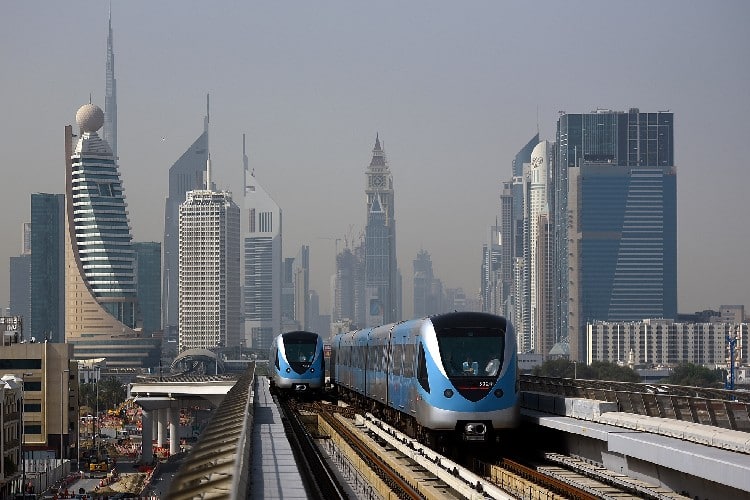
The Etihad Rail network is no longer an artist’s rendering and it is now a reality. In January, His Highness Sheikh Mohammed bin Rashid Al Maktoum took the first passenger ride between Dubai and Fujairah, underscoring how the UAE’s cities are becoming tightly linked by rail . Once fully operational, the network promises to connect Abu Dhabi and Dubai in just 30 minutes, while extending to key hubs like Reem Island, Saadiyat, Yas Island, and Al Jaddaf. In Dubai, the Blue Line metro expansion is another transformative leap. A 30-kilometer route with 14 new stations will tie emerging communities such as Dubai Creek Harbour, Mirdif, and International City directly into the urban core. Awarded in late 2024 and advancing rapidly through 2025, the Blue Line is more than a transport project it is a framework for where life in Dubai will cluster and thrive.
Real estate responds almost immediately to connectivity. Analysts now project 10–15% price and rent growth near Etihad Rail stations, with some hotspots like Saadiyat Island and Al Jaddaf poised for gains up to 25%. Rent increases of 10–15% within 12–24 months are also expected along the rail route.
The metro has already proven this dynamic. Between 2010 and 2022, properties within a 10–15-minute walk of Dubai Metro stations outperformed the market, growing 43.8%compared to the citywide average of 24.1%. With new stations in Dubai South and Al Quoz coming online, analysts forecast 6–8% growth in 2025 alone for those neighbourhood’s
The idea of commuting from one emirate to another no longer feels exhausting. A professional working in Abu Dhabi can now reasonably consider living in Dubai, Sharjah, or even Fujairah, without sacrificing hours to traffic. Families can prioritize lifestyle, schools, and affordability, rather than being tied to a single job location.
Transport also redefines neighborhoods. Around stations, new communities will spring up not just residential towers, but entire ecosystems with shops, schools, parks, and public spaces. This is transit-oriented development in action: creating places where people walk, connect, and build long-term roots.
Perhaps most importantly, better transport strengthens the UAE’s invitation to global talent. The country’s population has been rising steadily, driven by migration and opportunity, and improved mobility makes it more compelling not just for short-term stays, but for people seeking a place to settle long-term.
In 2025, the UAE is proving that newly improved methods of transportation will bring greater efficiency to daily commutes. For residents, this means shorter travel times, more choices, and stronger communities. For the property market, it represents long-term resilience built not on hype but on genuine human convenience.
If planning continues with vision integrating transport with homes, workplaces, and public spaces the UAE won’t just be more connected; it will be more livable, more inclusive, and more attractive for expats to settle in.

This article is contributed by, Mark Phoenix – CEO of Sankari
Disclaimer: All views and opinions expressed in The Brew Opinion – our opinion section – are those of the authors and do not necessarily reflect the official policy or position of TheBrewNews, the company, or any of its members.