
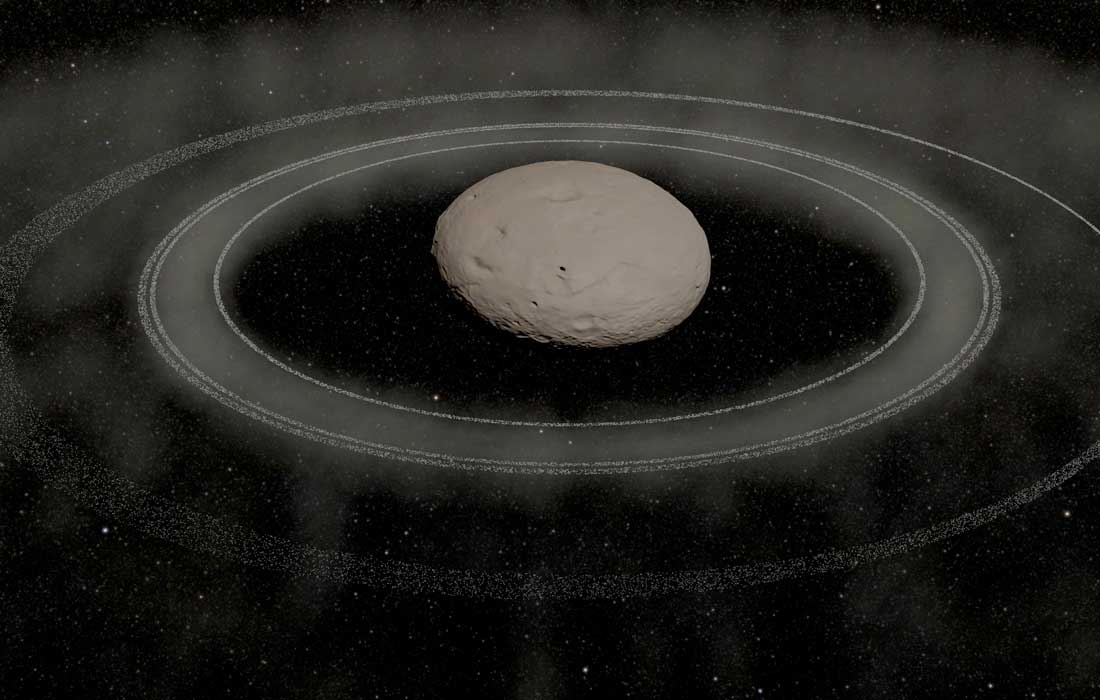

Scientists have observed ring formation around Chiron, a small icy centaur between Saturn and Uranus — a rare glimpse into ring evolution.
BRAZIL: In a fascinating breakthrough, astronomers have captured the formation of ring structures around a distant icy object named Chiron, located in the outer solar system between Saturn and Uranus. The discovery provides a rare real-time look at how ring systems emerge and evolve in deep space.
Formally known as (2060) Chiron, the 200-kilometre-wide celestial body is part of a group called centaurs, which display features of both asteroids and comets. While it has long been known that Chiron was surrounded by some material, new observations using Brazil’s Pico dos Dias Observatory, along with past data from 2011, 2018, and 2022, have confirmed the presence of four distinct rings.
The three inner rings are located approximately 170 km, 202 km, and 272 km from Chiron’s centre, while a fourth outer feature was spotted 1,400 km away — unusually distant for such a small object. This outer ring’s stability is still being studied.
The team, led by Brazilian astronomer Chrystian Luciano Pereira, revealed the rings are likely made of water ice mixed with rocky particles, much like those of Saturn. These findings were published in the Astrophysical Journal Letters.
What sets this discovery apart is the observation of ring evolution. Changes in the ring system across multiple observation periods show that the structures around Chiron are actively developing. Researchers believe the material may originate from comet-like activity, collisions with other space debris, or remnants from a destroyed moon.
The discovery was made through stellar occultation, a method where astronomers observe a distant object as it passes in front of a star. By tracking the dimming of starlight, the team was able to map Chiron’s environment.
This marks only the fourth small solar system body with confirmed rings, joining Chariklo, Haumea, and Quaoar. It highlights how ring formation is not exclusive to large planets like Saturn and Jupiter, but can occur wherever the right physical conditions exist.
“This evolving system gives us insights into how rings and satellites form around small bodies — with wider implications for understanding cosmic disk dynamics,” said study co-author Braga Ribas.