
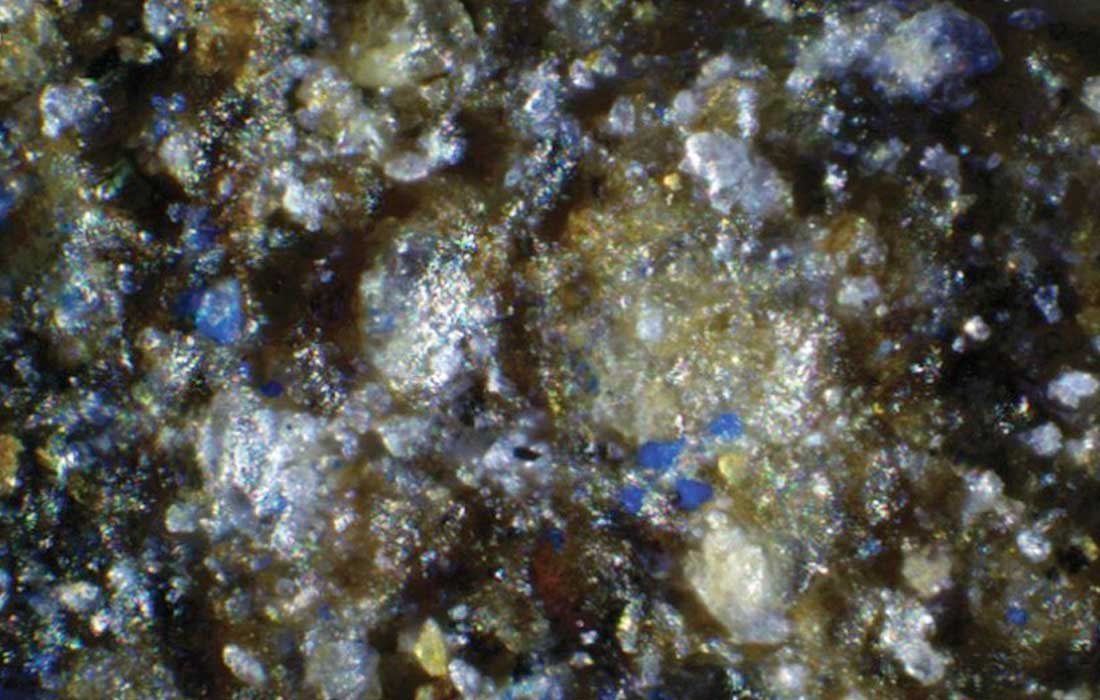

Researchers discovered azurite pigment on a 13,000-year-old artifact in Germany, making it the oldest-known use of blue pigment in Europe.
FRANKFURT: A re-examination of a small Paleolithic artifact from western Germany has stunned archaeologists after revealing traces of azurite, a deep blue mineral, on its surface—making it the oldest-known blue pigment in Europe. The discovery pushes back the continent’s use of blue colourants by nearly 8,000 years.
Originally thought to be a primitive oil lamp, the 13,000-year-old relic was unearthed decades ago at the Mühlheim-Dietesheim site near Frankfurt. However, recent scientific tests, including spectroscopy and geochemical fingerprinting, confirmed that the stone carries microscopic traces of azurite—a copper-based mineral that creates vibrant blue hues.
Led by archaeologist Izzy Wisher from Aarhus University, the research team published their findings in Antiquity on 29 September 2025. Their analysis also revealed that the azurite likely came from nearby sources, indicating that the region’s late Ice Age communities not only recognised local minerals but processed them deliberately—possibly for decorative or ritual use.
This blue pigment discovery challenges long-held beliefs that early European art revolved only around reds and blacks made from ochre and charcoal. Since blue rarely survives in archaeological settings, it was assumed absent in early symbolic traditions. But this finding suggests that ancient artists may have experimented with vibrant colours on perishable items like textiles, skin, or wooden objects now lost to time.
The stone’s reinterpretation—from “lamp” to likely colour-mixing palette—has broader implications. Experts believe that similar objects across Europe, previously mislabelled as lighting tools, may actually be art supplies used in pigment preparation.
The discovery paints a more colourful picture of Paleolithic expression—and hints that early Europeans had a richer visual culture than previously imagined.