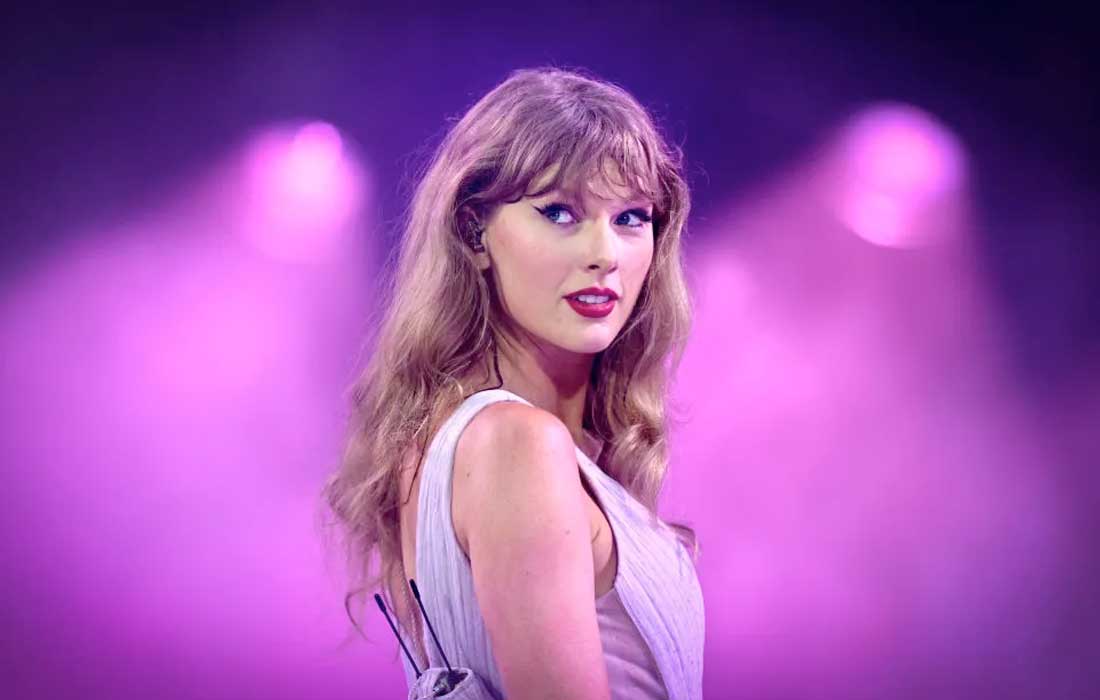

Taylor Swift’s “The Life of a Showgirl” promo campaign is under fire, as fans accuse it of using AI-generated visuals in teaser clips.
Taylor Swift might’ve just hit a sour note with some of her biggest fans. Her new album rollout for The Life of a Showgirl — which kicked off with a fun, glittery scavenger hunt around the world — has sparked controversy, and it’s all because of some strange-looking videos.
It all started when Swifties began scanning QR codes at bright orange doors that popped up in cities like London and Barcelona. The idea was to unlock mystery videos linked to the album. But fans quickly noticed something weird. One clip showed a Ferris wheel that bent mid-spin. Another featured a treadmill with buttons that seemed to… change shape? Lighting glitches, melting textures, even vanishing props — it all gave off serious AI vibes.
Within days, TikTok and X (formerly Twitter) exploded with the hashtag #SwiftiesAgainstAI, and the online sleuthing began. People started analysing the clips frame by frame, convinced that the visuals weren’t fully real — or at least, not fully human-made. The biggest shock? Fans said it felt like Taylor, who’s always stood for artistic integrity, might be cutting corners with artificial tools.
The backlash wasn’t just about weird visuals. It hit a nerve. Many pointed out that Taylor has spoken up before about protecting artists from AI misuse — especially during the SAG-AFTRA strikes — and has been critical of deepfakes. So if she’s now using AI in her own art, even just in promo videos, it feels like a plot twist nobody expected.
Taylor Swift is using AI-generated videos to promote her new album 🤯
— Justine Moore (@venturetwins) October 5, 2025
The future is here faster than you think… pic.twitter.com/yXV8YjtzzC
So far, Taylor’s team hasn’t said a word. The videos, which were first hosted on YouTube and Google’s interactive platform, have since been deleted or set to private. That move only fired up more speculation.
This is AI, watch the hanger randomly disappear
— Happi (@HappiiFunTime) October 4, 2025
Taylor swift a billionaire, is using AI for promotion. https://t.co/OyzamoLdtQ pic.twitter.com/f4rp7fWBCT
Some tech folks say it’s tough to prove if AI was really used — stylised editing and CGI could explain some of the “glitches.” But in the age of deepfakes and digital everything, fans are asking bigger questions: Where’s the line between real and generated? And if pop stars start leaning on algorithms, can their work still feel personal?
For an artist who’s built her empire on emotion, detail and storytelling, this moment feels like a new chapter — just maybe not the one fans were expecting.