
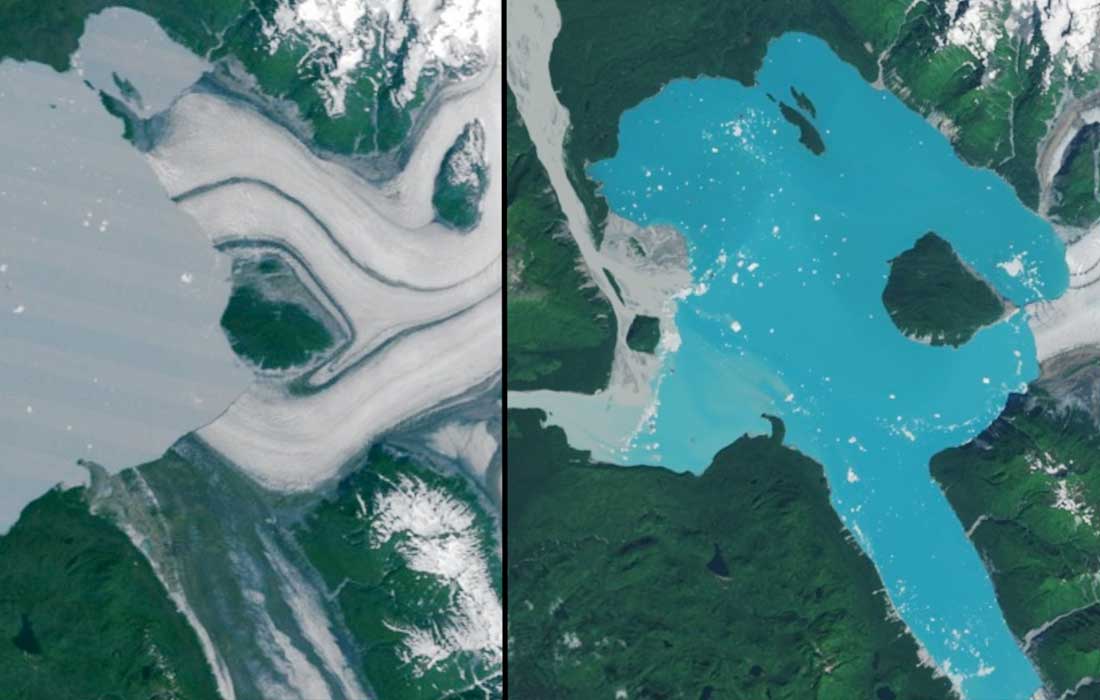

NASA confirms a new island has formed in Alaska’s Alsek Lake after glacier melt separated Prow Knob from the mainland.
JUNEAU: A new island has emerged in Alaska as a result of glacier retreat, according to NASA satellite imagery that captured the stunning transformation in the state’s changing geography. The discovery marks a striking example of climate-driven landscape evolution in real time.
The island, now completely surrounded by Alsek Lake, formed after the steady melt and retreat of Alsek Glacier, which once enveloped a small mountain known as Prow Knob. With both arms of the glacier retreating by more than 5 kilometres over the past 40 years, the mountain has become entirely isolated by water.
NASA’s analysis compared two satellite images: one taken on July 5 1984 by the Thematic Mapper on Landsat 5, and another on August 6 2025 by the Operational Land Imager-2 (OLI-2) aboard Landsat 9. These clearly show the glacier’s significant withdrawal and the formation of the new landmass, now officially classified as an island.
The new 5-square-kilometre island emerged sometime between 13 July and 6 August 2025, NASA confirmed. Glaciologists have closely monitored Alsek Glacier’s slow retreat, which has also led to the major expansion of Alsek Lake — growing from 45 square kilometres in 1984 to around 75 square kilometres today.
The phenomenon has been fuelled not only by Alsek Glacier but also by nearby lakes such as Harlequin and Grand Plateau, which have merged into a vast water body as ice masses continued to recede. Until around 1999, Alsek Glacier remained joined to the Grand Plateau Glacier’s northern arm — a connection that has since vanished.
NASA scientists now warn that the glacier, with its reduced stability, may experience more frequent calving events, where large chunks of ice break off into the lake, further reshaping the landscape.