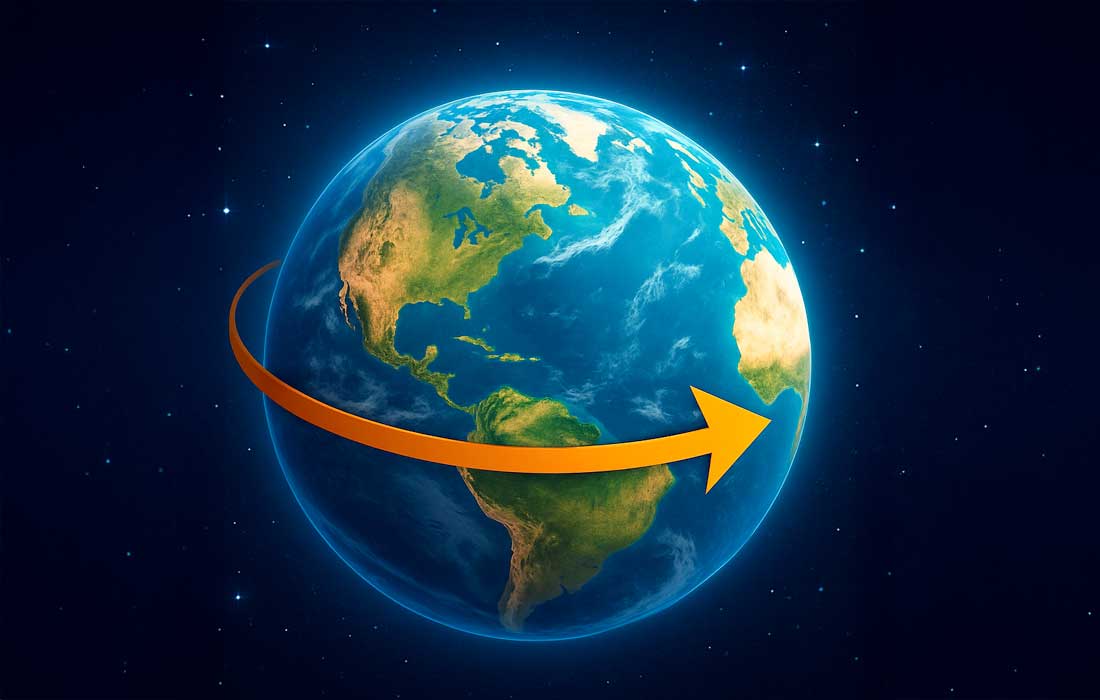

WASHINGTON D.C.: Scientists have confirmed that Earth’s rotation will speed up for just three days this summer, with the shortest day expected on 5 August. The phenomenon, tracked by the International Earth Rotation and Reference Systems Service (IERS), will see Earth’s daily spin accelerate by up to 1.51 milliseconds—an effect influenced by subtle astronomical and geophysical changes.
The three predicted shortest days of 2025—9 July, 22 July, and 5 August—are linked to the Moon’s position furthest from the equator, which temporarily impacts Earth’s rotational speed. While this might seem insignificant, it follows a larger trend noted by scientists since 2020: Earth is rotating slightly faster than usual. In fact, the record for the shortest day was set on 5 July 2024, when the planet spun 1.66 milliseconds faster than the standard 86,400-second day.
Experts at IERS say that, although Earth generally slows down over cosmic timescales, short-term variations can occur due to seismic activity, tidal shifts, volcanic events, and internal geological movements. These micro-adjustments in rotation are now measurable with atomic precision and may eventually lead to a rare leap second subtraction in 2029—a first in human timekeeping history.
Leonid Zotov, a geophysicist at Moscow State University, noted that the cause of this recent acceleration remains uncertain. “Most scientists believe it is something internal to the Earth,” he explained, adding that current oceanic and atmospheric models cannot fully account for the observed shift.
Despite the surprise uptick, Earth is still on a long-term path of slowing rotation. Over millions of years, days have gradually lengthened—scientists estimate that during the Mesozoic Era, dinosaurs lived through 23-hour days. In the future, Earth days may stretch to 25 hours, unless surface factors like melting ice caps reverse that trend.