
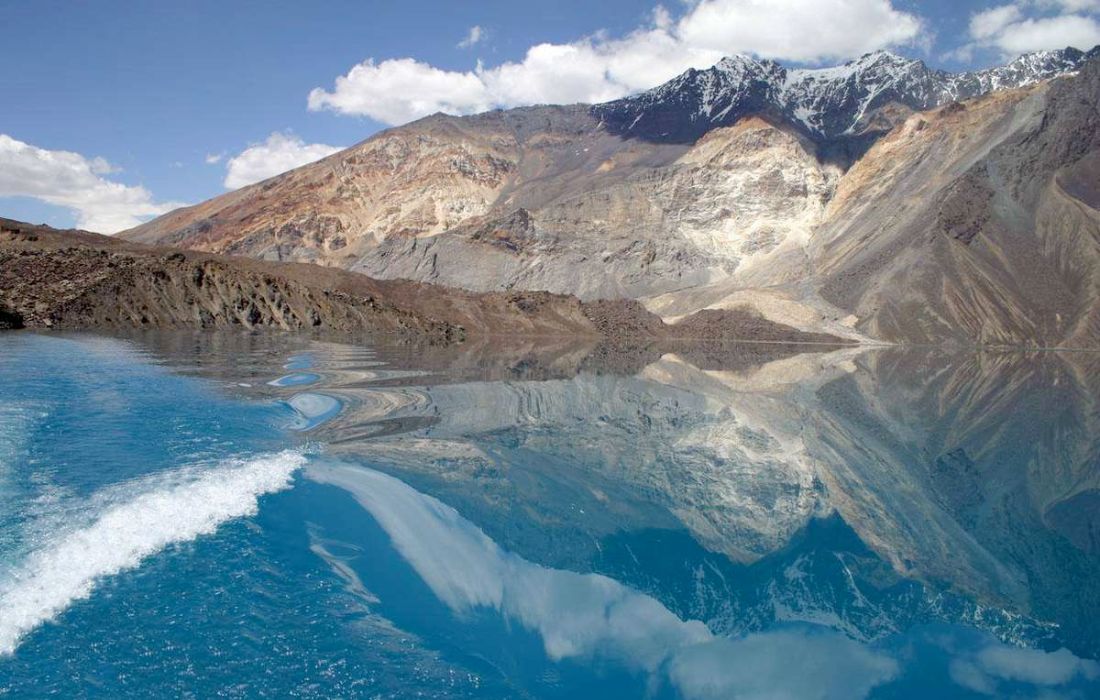

Kuwait: Ambassador of Tajikistan to Kuwait, Zubaydullo Zubaydzoda, announced a significant project to export freshwater from Sarez Lake in Tajikistan to Gulf countries and other regions facing water scarcity.
This announcement was made during a meeting in partnership with the United Nations Office in Kuwait, where he discussed the current state of affairs of the 3rd High-Level International Conference on the International Decade for Action “Water for Sustainable Development,” 2018-2022. He highlighted that Sarez Lake, spanning 61 kilometers in length and 500 meters in depth, is a substantial freshwater source.
Tajikistan, which holds about 60 percent of Central Asia’s water resources, also has some of the region’s lowest electricity tariffs. The country plans to export electricity from the under-construction Rogun Hydropower Plant to neighboring countries such as India, Afghanistan, and Pakistan. This plant, situated on the Vakhsh River, will have six 600 MW power units with a total capacity of 3,600 MW, making it the largest hydroelectric plant in Central Asia.
Also read: Mohamed bin Zayed Water Initiative pushes innovative solutions in enhancing Global Water Security
Kuwait excluded from Tajik visa
Moreover, the Tajik ambassador said this relationship expands into the tourism sector, inviting visitors from Kuwait to appreciate its beauty. He emphasized the ease of travel, noting that Kuwaiti citizens do not require visas, while expatriates can obtain visas upon arrival in Tajikistan. Additionally, there is a direct travel route from Kuwait to Tajikistan.
As the Dean of the Diplomatic Corps in Kuwait, Zubaydzoda emphasized the strong bilateral relationship between Kuwait and Tajikistan. He mentioned their commitment to fighting terrorism together in the upcoming International Conference on Combating Terrorism and its Financing, part of the “Dushanbe Process.” Scheduled to take place in November in Kuwait, this conference underlines the importance of the initiative. “Our bilateral relations with Kuwait are crucial. We aim to strengthen our ties in all areas, especially in politics,” Zubaydzoda said, adding that political discussions between the two countries are scheduled to occur in Dushanbe in June.
Reinforcing political ties
He discussed the upcoming Water for Sustainable Development conference in Dushanbe, set for June 10-13, 2024. The conference aims to enhance collective efforts and support the implementation of commitments made in the UN Water Conference’s Water Action Agenda. It will focus on sharing best practices, fostering partnerships, and emphasizing water’s role in sustainable development.
The conference aims to spread awareness and build political support to accelerate progress toward achieving the water-related goals of the 2030 Agenda. It will contribute to the 2024 High-Level Political Forum on Sustainable Development and the preparatory process for the UN Water Conference in 2026.
The conference will also encourage governments, the United Nations, and other partners to translate commitments into actions and catalyze new pledges to be registered in the Water Action Agenda. “It should be noted that there is almost no region in the world currently that does not experience water issues, and according to the analysis, this issue will become even more complex unless effective collective measures are taken,” stated Zubayzoda.
Ghada Al-Taher, UN Resident Coordinator to Kuwait, expressed gratitude to Zubaydzoda for this initiative. “The United Nations values its relationship with Tajikistan and its role in hosting the annual water conference, demonstrating its commitment to elevating water issues,” she said.
She stressed the importance of access to clean water as a fundamental human right and its critical role in sustainable development. Taher recognized global challenges in this area, noting that over 2.2 billion people face hardships due to water scarcity and climate change.
Tackling water issues
She pointed out the trend among nations to ensure access to safe and clean water and improve sanitation services. “The effects of climate change are evident worldwide, leading to droughts or floods, both resulting in significant losses affecting food security and quality of life,” she commented. She mentioned Kuwait as one of the countries affected by climate change.
In regards to the UN Office in Kuwait’s support for the government in elevating water sustainability, Taher also discussed their role in offering consultations on water provision as an essential human right. This aligns with the Sustainable Development Program and Kuwait Vision 2035, emphasizing cooperation within this framework.
“Cooperation involves providing consultations to the Kuwaiti government through partnerships with specialized UN programs and organizations, such as the UN Development Program, Human Settlements Program and UN Environment Program. These organizations offer consultation not only on water but also on environmental matters like sandstorms, funded by the Kuwait Development Fund,” Taher stated.
“Water consumption should be an individual responsibility, not just a governmental concern,” she said, further adding that raising awareness about the consequences of water scarcity and promoting efforts to reduce its effects due to climate change are crucial.
Tajikistan freshwater Kuwait Gulf