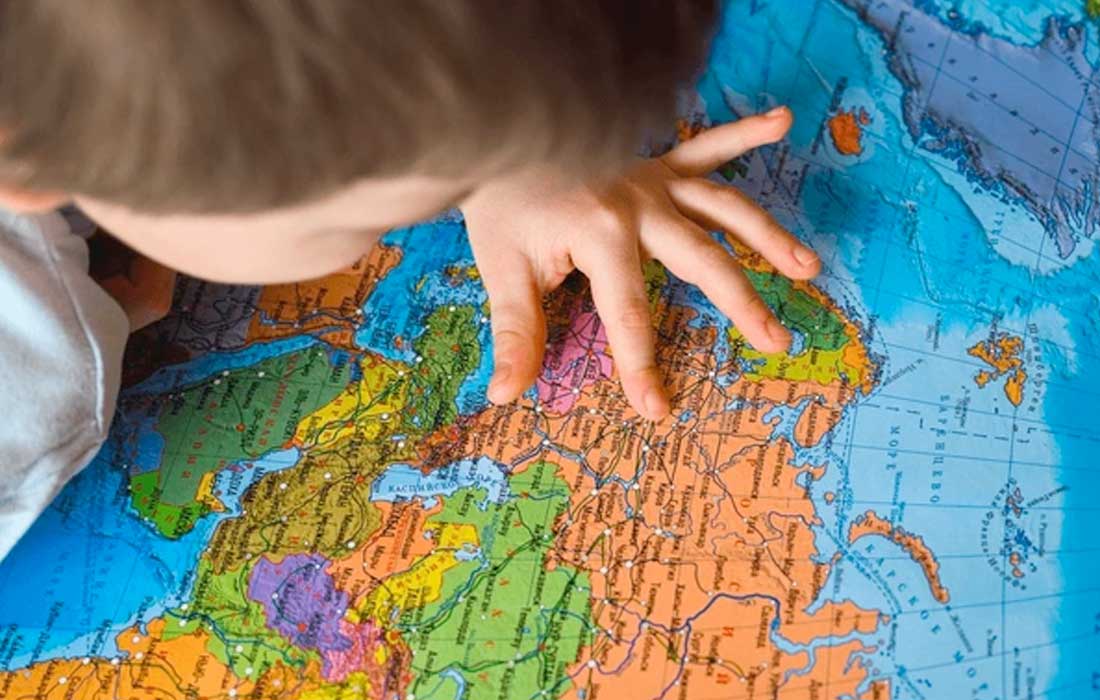

Smart tips to remember geography maps with ease (Part 2). Continuing from Part 1 of this article; let us learn some more effective ways to remember Geography Maps with ease.
As I had explained earlier, learning maps can be a fun process. Both school and college students must write answers to map reading questions in full sentences. Here are six additional Vital Tips to remember maps:
- Write down the places you can’t remember on paper so that you know you need to focus on them.
- Once you start learning the map, avoid unnecessary distractions. Focus completely on the map for some time before switching to another subject.
- It is very helpful to link the places you are learning on the map with current affairs. Keep an eye on headlines from those places, observe their geographical features, and try to co-relate them. Make this a regular habit—it helps.
- Go through the political map of the country carefully. Look at where the mountains, terrains, and major rivers are. Focus on major rivers and avoid spending too much time on minor ones as they may divert your attention.
- To memorise the map, print out copies of a world map to colour or use for practice. Colour-coding different continents and countries can help build visual associations and turn it into a Fun Cum Learn activity.
- Blank maps can also be very useful for studying and testing yourself on the location of countries.
There are 7 continents, but when learning, focus on one continent at a time. Trying to cover the entire map at once can affect your concentration and make memorisation more difficult. If necessary, cover parts of the map you’re not focusing on to keep your eyes from wandering.
Keep in mind that concentration involves proper attention span. A long attention span of 30–45 minutes leads to optimum levels of concentration. Understand the map well—when you understand what you are studying, you retain it better.
It’s beneficial to study a map for a short period and then test your memory by inserting the names of rivers, mountain ranges, states, cities, and countries until you can fill out an entire blank map.
Always remember the basic map skills:
- Map Title – tells what the map shows
- Compass Rose – shows cardinal directions
- Key – explains the symbols, colours and shapes
- Scale – shows the distance between two points
Also, learn important map elements like scale bar, north arrow, border, locator, etc., and the three components of a map: distance, direction, and symbol.
In conclusion, maps are an important part of geography and everyday life. It’s useful to be good at maps, so one should always try to learn them with fun and interest, which will ultimately benefit the individual. states at the foot of the Himalayas — the world’s tallest mountain range. Also mark the cluster of northeastern states of India, which border China and Myanmar.
Also read: Does visualization help to enhance your memory?
About the writer: Minoo Jokhi is a Mathemagician cum Memory Development Trainer based in Mumbai, India. He trains people of all ages right from 4 to 80 years of age and shows them how to increase their Memory-Power and once and for all shatter the myth that memory is neither good nor bad but in reality, is trained or untrained. Readers can contact him via email at minoojokhi@rediffmail.com or follow him at http://www.minoojokhi.in/
Disclaimer: All views and opinions expressed in The Brew Opinion – our opinion section – are those of the authors and do not necessarily reflect the official policy or position of TheBrewNews.com, the company, or any of its members.