
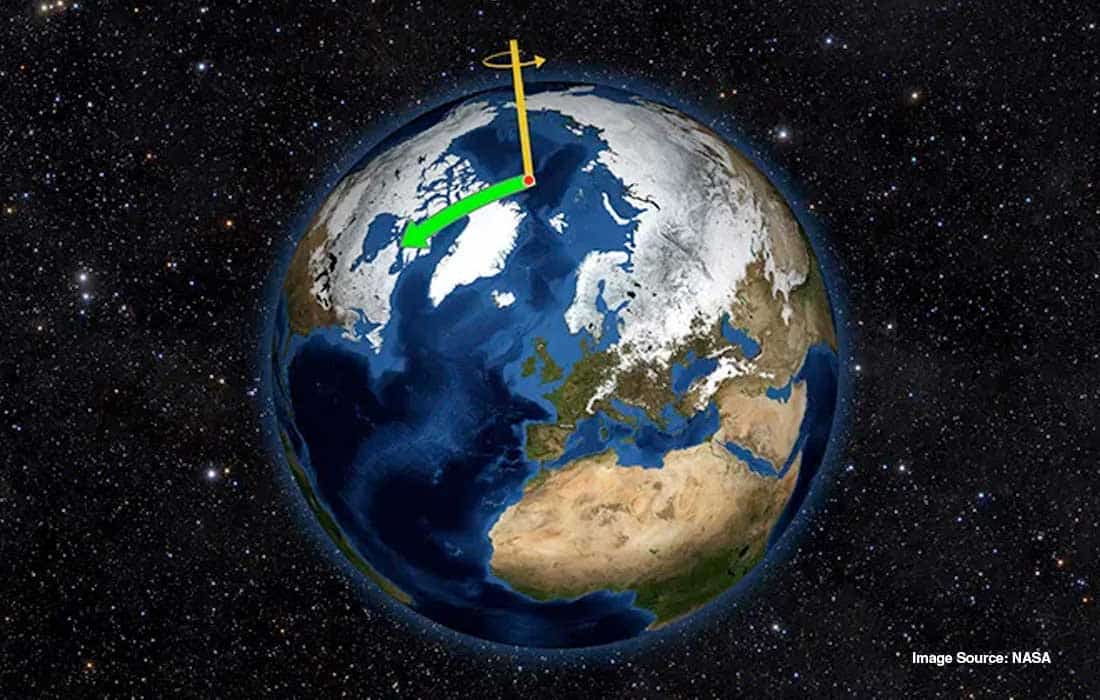

WASHINGTON: New studies using AI show that climate change is making days longer on Earth and causing the planet to wobble more. Researchers used a smart program that combines real-world data with physics to predict these changes.
The length of a day on Earth is about 86,400 seconds, but this can change by tiny fractions of a millisecond each year due to various factors like tectonic plate movements, changes in the inner core’s rotation, and the moon’s gravitational pull. Now, human-caused climate change is also affecting how long our days are on Earth and also for it to wobble more.
Research funded and published by NASA, reveals that climate change is continuously altering Earth’s spin. Initially, these changes will be too small for us to notice, but they could have serious long-term effects. These include needing to adjust our clocks with negative leap seconds, disrupting space travel, and even affecting Earth’s inner core.
Also read: Sustainable City Dubai launches delivery robots
One major factor is the rapid ice loss in polar regions like Greenland and Antarctica due to global warming. This ice melt increases sea levels, and most of this extra water ends up near the equator. This makes the planet bulge slightly around the middle, which slows down its spin, similar to how a spinning figure skater slows down by extending their arms.
The new AI program provides more precise estimates of how Earth’s days will lengthen over time. These findings support a similar study from March, which also suggested that days would get longer in the future.
In short, climate change is not only warming our planet Earth but also changing how it spins. This could have big implications for our future, affecting everything from our clocks to space missions.