
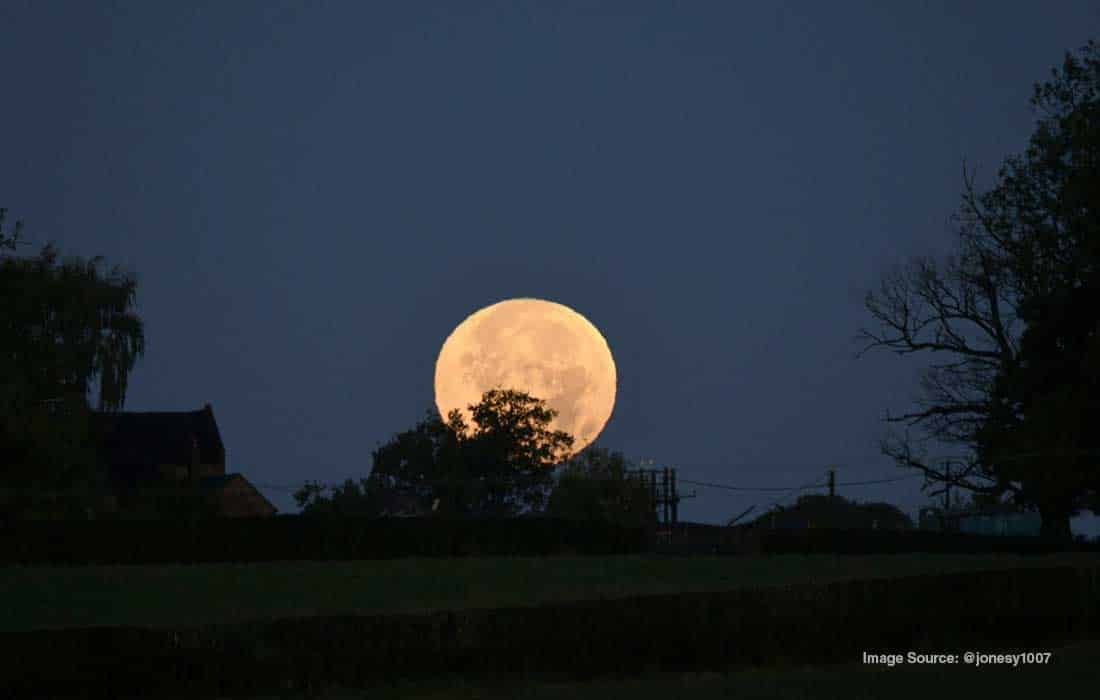

The Hunter’s Moon, also called the October Full Moon, illuminated the night sky this week, peaking last night on Thursday, October 17 at 7:26 a.m. EDT (4:56 in the afternoon) Institute of Science and Technology (IST). NASA states that the moon will be at its brightest during this time period, and its beauty can be admired from Tuesday night to Friday morning. This moon is set to be a breathtaking sight for those who like watching celestial events.
What does the term “Hunter’s Moon” refer to?
The Hunter’s Moon follows the Harvest Moon and is the nearest supermoon to the autumnal equinox. The historical importance of the phrase “Hunter’s Moon” was first documented in 1710 in the Oxford English Dictionary.
Traits of the Hunter’s Moon
Luminosity: This particular full moon shines brighter and ascends sooner than other full moons.
Increased brightness at twilight benefits hunters by providing additional light just after sunset.
The moon moves parallel to the horizon, creating a brief time between moonrise and sunset.
Usually, the moon appears approximately 50 minutes later each day. Nonetheless, the Hunter’s Moon and the Harvest Moon exhibit distinct behaviours.
The close overlap of sunset and moonrise results in prolonged twilight and extra evening lighting.
The full hunters moon, supermoon, as it set this morning 7:20am over Shropshires fields #supermoon #huntersmoon #FullMoon #moonHour @MoonHourSocial #loveukweather pic.twitter.com/8BenGFp40q
— Chris Jones (@jonesy1007) October 17, 2024
Why is it called the Hunter’s Moon?
The term “Hunter’s Moon” is connected to the practice of hunting as a way to get ready for winter. Its roots can be linked to ancient farming and hunting traditions seen in numerous societies, especially in the North Hemisphere.
Post-harvest: Following the Harvest Moon, fields are emptied of crops, leading game animals such as deer to search for food in open areas, which makes them more susceptible to hunters.
Optimal hunting time: The luminous glow of the Hunter’s Moon prolongs hunting opportunities post sunset.
The Maine Farmer’s Almanac played a role in spreading awareness by publishing Native American names for full moons in the 1930s.
Also read: NASA launches mission to investigate potentially habitable ocean world
Observing the Hunter’s Moon
No special gear is needed for those anxious to see the Hunter’s Moon in October. The naked eye will be able to see the moon, providing enjoyment for people in most places around the world.
The next full Moon will appear in the sky starting on Oct. 17, and will be the third supermoon this year. 🌕
— NASA Marshall (@NASA_Marshall) October 16, 2024
This full Moon is also known as the Hunter's Moon, perfect for any werewolves out there craving an adventure! 🐺
Learn more >> https://t.co/e3U39MxmBX pic.twitter.com/NQ0NHmOrw0
(This article is published under a mutual content partnership arrangement between The Brew News and The Free Press Journal)