
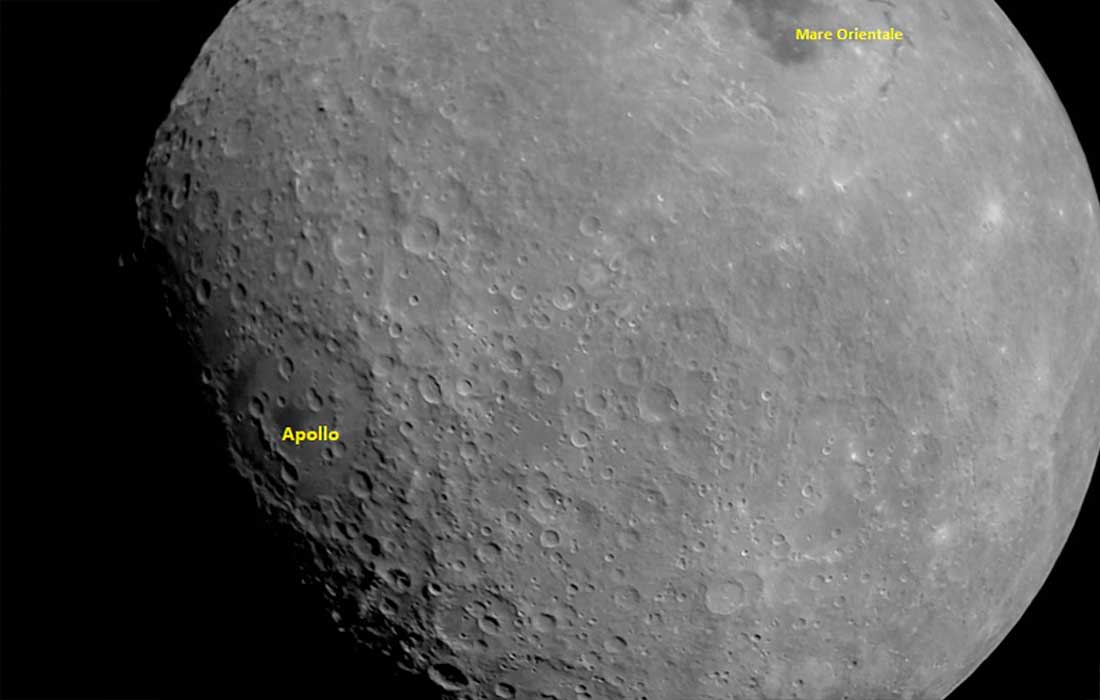

Lunar samples from China’s Chang’e-6 mission reveal the Apollo Basin formed 4.16 billion years ago, reshaping theories of the moon’s early impacts.
BEIJING: An international team of researchers, working with lunar samples from China’s Chang’e-6 mission, has determined that the Apollo Basin on the far side of the moon was formed around 4.16 billion years ago. The finding, published in Nature Astronomy, offers vital insights into the timeline of the Late Heavy Bombardment (LHB) — a period of intense asteroid impacts that shaped both the moon and the solar system.
The Apollo Basin lies within the South Pole–Aitken Basin, one of the largest known impact structures in the solar system. Scientists have long debated whether the LHB was a gradual decline in asteroid impacts or whether there was a sudden surge around 3.8–4 billion years ago. Until now, precise sample-based age data for key lunar basins has been lacking.
The Chang’e-6 probe, which landed in the Apollo Basin last year, collected a series of samples, including three unusual impact-melt clasts ranging from 150 to 350 micrometres in size. These fragments, analysed by researchers from the Chinese Academy of Sciences’ Guangzhou Institute of Geochemistry led by Xu Yigang, acted as a “geological clock” for the impact event.
By integrating geochemical analysis with remote sensing data, the team determined that the Apollo Basin formed about 4.16 billion years ago, pushing back the timeline for the onset of the LHB by at least 100 million years. The findings also suggest that the LHB impact flux followed a gradual decay, contradicting theories of a sudden peak.
The study not only refines understanding of the moon’s geological history but also sheds light on the early evolution of the Earth–moon system. Researchers say continued analysis of Chang’e-6 samples will deepen knowledge of planetary formation and the solar system’s ancient impact record.