
DUBAI: The UAE’s non-oil foreign trade surged to a historic AED1.728 trillion in the first half of 2025, marking a 24% year-on-year growth, according to His Highness Sheikh Mohammed bin Rashid Al Maktoum, Vice President, Prime Minister of the UAE and Ruler of Dubai. The significant leap underlines the country’s success in strengthening its global trade presence under the leadership of President His Highness Sheikh Mohamed bin Zayed Al Nahyan.
In a post shared on the “X” platform, Sheikh Mohammed highlighted the nation’s rapid economic progress, noting the trade figures have more than doubled compared to the same period in 2021. “We recorded double what we achieved in the first half of 2021 and continued the unprecedented boom in our trade with historic growth rates of 59.5% and 37.8% compared to the first half of 2022 and 2023,” he stated.
Sheikh Mohammed attributed much of this growth to the Comprehensive Economic Partnership Agreement (CEPA) programme launched in 2021. To date, 28 CEPA deals have been signed, with 10 already in force, facilitating trade access to markets home to nearly 3 billion consumers. He noted the increase in non-oil exports, which reached AED369.5 billion—up by 44.7% from 2024 and more than doubling compared to 2022.
His Excellency Dr. Thani bin Ahmed Al Zeyoudi, UAE Minister of Foreign Trade, said the growth of the UAE’s non-oil foreign trade over recent years is thanks to the vision of the leadership and the national strategy of expanding the UAE’s network of trade and investment partners around the world through the Comprehensive Economic Partnership Agreements (CEPAs) program. Announced in September 2021, 28 agreements have been completed, 10 of which have entered into force. These agreements provide barrier-free trading access to markets with a population of around 3 billion.
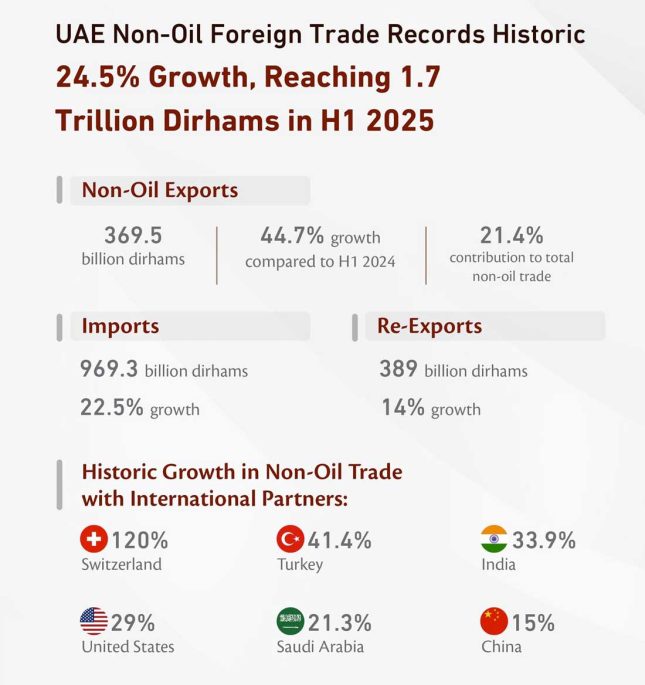
His Excellency said that this vision of openness to the world was a major catalyst for the growth witnessed by the UAE’s non-oil trade in recent years, which accelerated during the first half of this year, recording a total value of AED1.728 trillion. This is a rise of 24.5% year-on-year, compared to H1 2024. Non-oil trade in H1 2025 rose by 37.8% and 59.5% compared to the same period in 2023 and 2022 respectively, and doubled the figure achieved in H1 2021.
He added that the expansion of the UAE’s network of trading partners through the CEPA program has contributed significantly to the record boom of non-oil foreign trade. For example, bilateral trade with India increased by 33.9%, fueled by the entry into force of a CEPA in May 2022. Meanwhile, bilateral trade with fellow CEPA partner Türkiye increased 41.4%.
The UAE’s exports to its CEPA partners amounted to AED85.02 billion, a growth of 62.8%. This accounted for 23% of the UAE’s total non-oil exports. India received AED51.45 billion in re-exports in H1 2025, a growth of 97.6% compared to 2024 for the same period. They were followed by Türkiye, with AED27.2 billion and a growth of 24.1%. Exports to the ten countries with which CEPAs came into force increased 3 times compared the level recorded in 2022 and 2021, and exceeded 4 times the level from 2019.
H.E. Al Zeyoudi pointed out that the UAE’s non-oil exports continued to achieve unprecedented historical growth rates, reaching AED369.5 billion H1 2025, with a growth rate of more than 44.7% – for the first time in the country’s history – compared to the same period in 2024, as well as a growth rate of 80% compared to the first half of 2023. This figure is also double the value of non-oil exports during 2022, more than double the value achieved in 2021 and 3 times the level recorded during 2020 and 2019 for the same period. Non-oil exports were the best performers among the UAE’s foreign trade during H1 2025, contributing 21.4% of the UAE’s total non-oil trade. This was higher than the 21% contribution in Q1 2025, as well as its share in H1 of 2024 and 2023, where it was 18.4% and 16.4% respectively
During H1 2025, the most important destinations for the UAE’s non-oil exports were Switzerland, followed by India, Türkiye, and Hong Kong-China. Thailand, Switzerland and India recorded the highest growth rates among the UAE’s export receiving markets.
H.E. Al Zeyoudi confirmed re-export growth continued in H1 2025, reaching AED389 billion, with a growth of 14%, 15.8% and 25.4% compared to the corresponding periods of 2024, 2023 and 2022 respectively. Re-exports of the top 10 partners recorded a growth of 16.5%. Nations from the rest of the world recorded a growth of 12% when compared to H1 2024. The most important re-export goods included telephones, diamonds, cars, gold jewelry, aircraft parts and computers, but the largest growth was in the re-export of aircraft parts, gold, gold jewelry and cars. The countries that achieved significant growth in receiving re-exports from the UAE included Saudi Arabia, Iraq, Oman, Turkey and Qatar, with France receiving the highest percentage in H1 2025.
H.E. Al Zeyoudi said that the UAE’s imports of non-oil goods amounted to AED969.3 billion during H1 2025, a growth of 22.5% compared to H1 2024. The UAE’s imports from the top 10 trading partners increased by 20.8% and from the rest of the world by 24.3%. The most important imported goods during H1 2025 included gold, telephones, cars, petroleum oils, jewelry and jewellery, diamonds, and computers.
H.E. Al Zeyoudi added that the UAE’s non-oil trade with the top 10 trading partners also continued its upward trajectory in H1 2025 with a growth of 25.5% and an increase of 23.6% with nations from the rest of the world. Non-oil trade with India increased by 33.9%, with China by 15.6%, and Switzerland by 120%. Saudi Arabia achieved a growth of 21.3% compared to the same period in 2024, Türkiye saw a rise 41.4%, and trade with the USA witnessed a growth of 29%, meaning America ranked sixth among the country’s top 10 trading partners around the world. France entered the list of top 10 partners in H1 2025.
Notably, non-oil exports made up 21.4% of total non-oil trade, their highest ever share, up from 18.4% in 2024 and 16.4% in 2023. Key export destinations included Switzerland, India, Turkey, and Hong Kong-China, with India showing a 97.6% growth and Switzerland at 120%.
Re-exports also climbed to AED389 billion, a 14% increase over 2024, while non-oil imports grew by 22.5% to AED969.3 billion. Overall trade with India rose by 33.9%, with Turkey by 41.4%, and with the United States by 29%.
The UAE’s impressive trade figures reinforce its position as a key global trade hub and a trusted economic partner, offering strong access to dynamic global markets.