
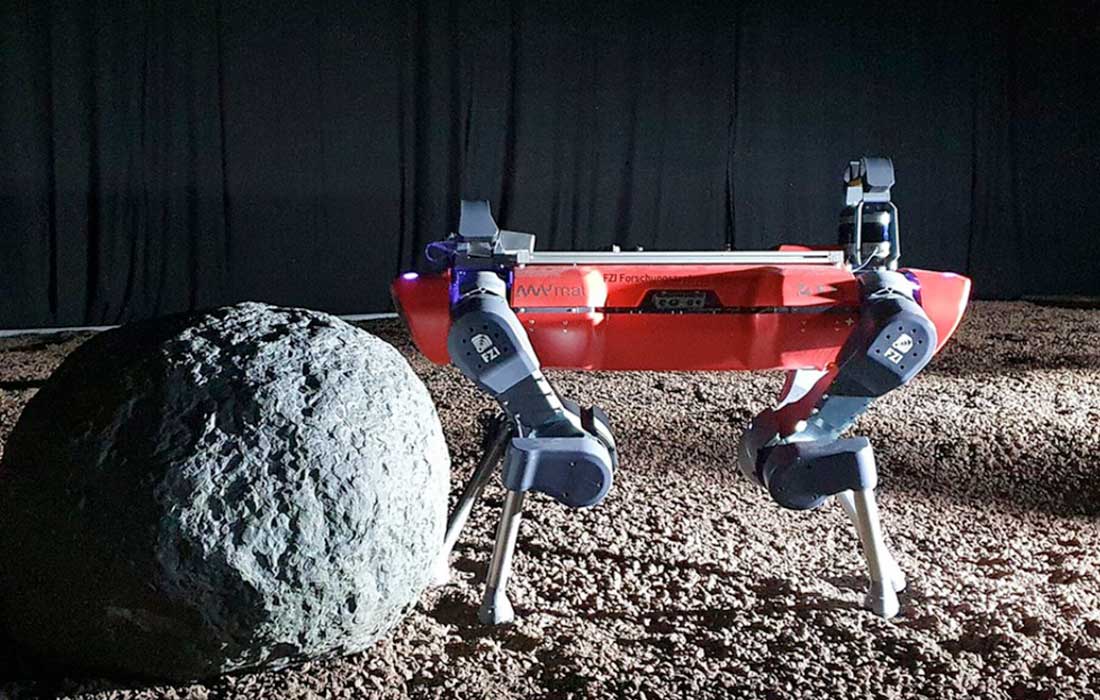

Chinese researchers at Peking University are training robotic dogs in moon-like caves to prepare for future lunar exploration and underground base development.
BEIJING: China has begun testing robotic dogs designed for lunar exploration, simulating moon-like underground conditions to prepare for upcoming missions that aim to explore and utilise the moon’s subsurface environments.
According to the South China Morning Post, researchers from Peking University’s School of Computer Science have developed two specialised robots to navigate challenging lunar terrains. The prototypes were tested in a lava-formed cave near Jingbo Lake, in Heilongjiang province, whose geological structure closely resembles the moon’s underground lava tubes—areas considered ideal for future human lunar bases.
In the tests, researchers deployed the robotic dogs into narrow, rugged sections of the cave that were inaccessible to humans. Equipped with LiDAR-based remote sensing, the robots could autonomously map the cave’s 3D structure, avoid obstacles, and capture high-precision spatial data.
“This testing in a lunar-like lava tube environment allows us to advance embodied intelligence technologies for deep-space exploration,” said Zhang Shanghang, researcher at Peking University and the Beijing Academy of Artificial Intelligence (Zhiyuan Institute).
One prototype, inspired by anteaters, integrates a flexible robotic arm with a rigid mobile platform to perform digging and exploration tasks autonomously. These adaptable systems are expected to pave the way for robots capable of performing multiple functions—ranging from mapping to sample collection—in extreme extraterrestrial environments.
The university’s long-term goal is to develop a fully independent deep-space exploration robot capable of operating on the moon and Mars.
The project underscores China’s growing ambitions in robotic space exploration and the use of AI and embodied intelligence to enable safer and more efficient missions on celestial bodies.