
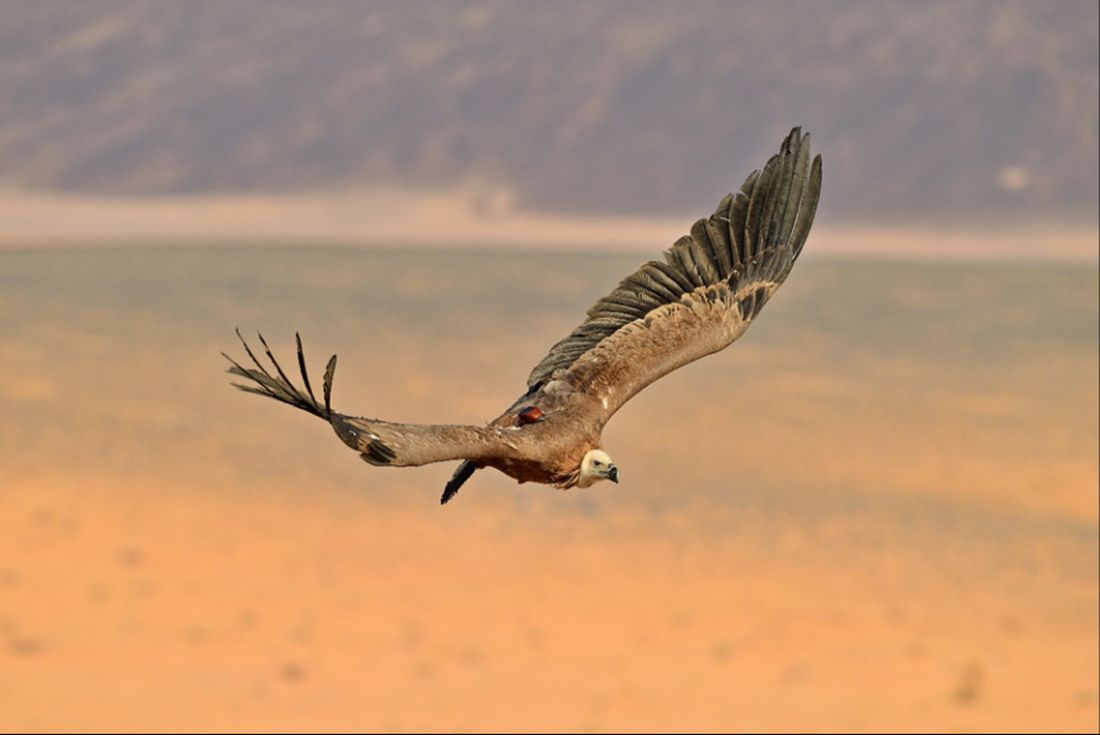

Two Eurasian Griffon vultures tagged in Saudi Arabia travelled 245,632 km across eight countries, highlighting urgent regional conservation needs.
RIYADH: Two endangered Eurasian Griffon vultures released by the Prince Mohammed bin Salman Royal Reserve have flown a combined 245,632 kilometres across eight countries since April 2023, providing groundbreaking data for regional conservation efforts.
The birds were fitted with solar-powered satellite tags as part of International Vulture Awareness Day, giving Saudi Arabia its first real-time insights into the species’ movements. Their journeys have taken them through Jordan, Syria, Iraq, Turkey, Armenia, Azerbaijan, and Iran, in addition to Saudi Arabia.
One vulture travelled more than 119,000 km, reaching Armenia and Azerbaijan after returning briefly to southwestern Saudi Arabia. It flew at altitudes of up to 6,527 metres and speeds of 123 km/h, enduring temperatures ranging from 9°C to 54°C. The second bird covered 126,133 km, reaching an altitude of 9,029 metres and speeds of 128 km/h before settling in Turkey and Iran.
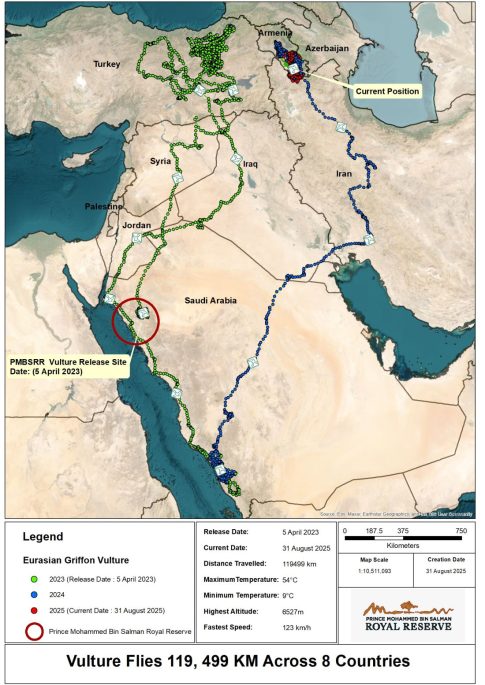
“These birds have flown the equivalent of six trips around the Earth in under 30 months,” said Andrew Zaloumis, CEO of the Reserve. “The data underscores the urgent need for cross-border conservation strategies, especially at a time when 16 of the world’s 23 vulture species are at risk of extinction.”
The project, run in collaboration with the National Centre for Wildlife, is part of a wider initiative to rehabilitate and rewild large migratory species in Saudi Arabia. The 24,500 km² Reserve offers ideal nesting and roosting habitats for vultures, with recent monitoring confirming four active nests across three breeding colonies in September 2024.
Vultures play a crucial role in ecosystems as nature’s “clean-up crew,” preventing the spread of disease by consuming carcasses. Yet they remain highly threatened due to poisoning, habitat loss, poaching, and electrocution from power lines.
Saudi Arabia is committed to sharing its findings with global conservation partners, including BirdLife International and the Convention on Migratory Species (CMS), to support regional and international action plans. With eight scientific papers already published and five more underway, the Reserve is contributing critical data to help secure the survival of migratory species across borders.